
COMPARISON
Mendworthy vs Redux
Both recover failed Stripe payments. Redux runs its own retry engine and bills a percentage of what it recovers; we stay flat from $79/mo — never a percentage of your recovered revenue — with SMS and live holdout lift measurement built in, for any Stripe subscription.
Which one fits
Both products recover failed Stripe payments. The right pick depends on scope, pricing predictability, and how much you care about lift measurement.
Pick Mendworthy if
- You want a known flat monthly fee that never takes a cut of recovered revenue.
- You want SMS in the recovery sequence, not just email.
- You want lift proven against a live holdout control group, not a historical baseline.
- You want recovery that works the same whether you're B2B, B2C, or a mix — no segment lock-in.
Pick Redux if
- You're a high-volume B2C consumer app and want retry timing tuned to consumer banking behavior.
- You'd rather pay a percentage of recovered revenue than a fixed subscription.
- You want an AI engine deciding retry timing on top of Stripe's.
- Email-only recovery outreach is enough for your customers.
Feature by feature
Verified July 2026 · reduxpayments.com
| Mendworthy | Redux | |
|---|---|---|
| Recovery emails | ✓ | ✓ |
| SMS recovery | Growth+ | — |
| One-tap card update (no login) | ✓ | ✓ |
| Card-update page on your own domain | Scale | — |
| Own retry-timing engine (beyond Stripe) | Stripe's Smart Retries | ✓ |
| Live holdout lift measurement | ✓ | — |
| Built for | Any Stripe subscription | B2C |
| Pricing model | Flat from $79/mo | 25% of recovered lift |
The pricing math
Both products price differently. Here's what you'd pay at three SMB scale points.
Lower recovery volume
Mendworthy
$79/mo · Starter
Redux
25% of recovered lift
Growing recovery volume
Mendworthy
$149/mo · Growth
Redux
25% of recovered lift
Higher recovery volume
Mendworthy
$299/mo · Scale
Redux
25% of recovered lift
The holdout-measured difference
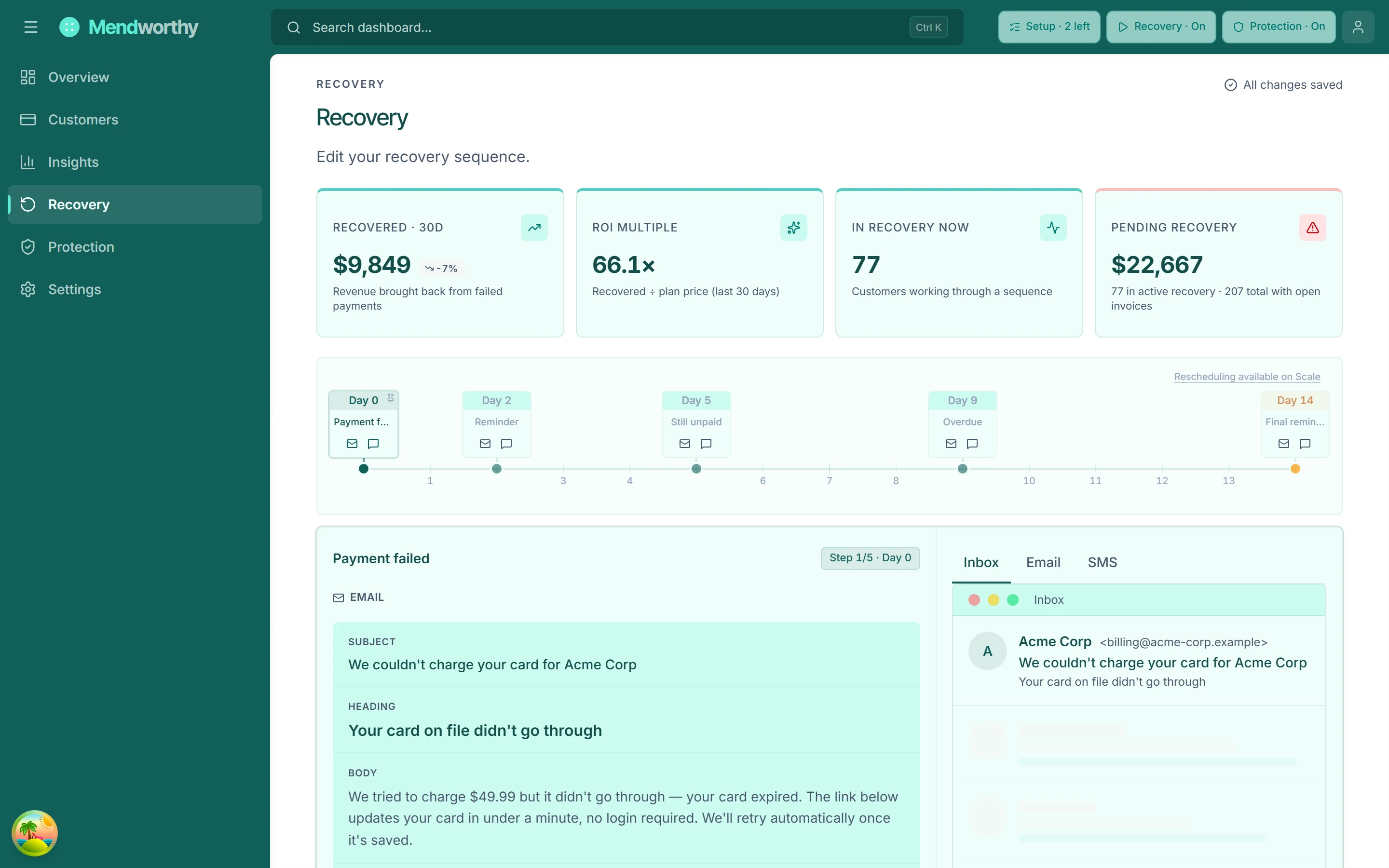
Live lift chart on every dashboard. Control cohort gets no outreach; test cohort gets the full sequence. The gap is the recovery you actually drove.
Scope, honestly
We're not trying to win every row. Some things Redux does that we deliberately don't — and vice versa.
What Redux does that we don't
- Runs its own retry-timing on top of Stripe's, choosing when to re-attempt each failed charge.
- Positioned specifically for B2C consumer subscriptions.
- Performance-based billing — a percentage of recovered revenue instead of a subscription.
- Installs directly inside Stripe as a listed partner.
What we do that Redux doesn't
- SMS in the recovery sequence, not just email (Growth and up).
- A flat monthly fee that never takes a percentage of recovered revenue.
- A live holdout control group measuring real lift — not a historical baseline.
- Card update on your own branded domain (Scale).
Switching from Redux
- Both connect through Stripe — no data migration step.
- Redux installs as a Stripe app; remove its access, then connect Mendworthy via OAuth.
- Card data stays in Stripe. Neither tool stores card numbers.
- Retry scheduling doesn't transfer: Mendworthy leaves retries to Stripe's Smart Retries and runs the customer outreach + card update. Your Smart Retries keep working as-is.
Common questions
Try Mendworthy
Join the waitlist. We'll notify you the moment Mendworthy is live on Stripe.
Still weighing options? Mendworthy vs Baremetrics Recover · Mendworthy vs FlyCode · Mendworthy vs Churnkey · Mendworthy vs Stunning · See pricing · Back to home
Facts about Redux on this page verified 2026-07-22 against www.reduxpayments.com/pricing. We re-verify quarterly; if you spot anything outdated, email [email protected].